
By Rashad Reza
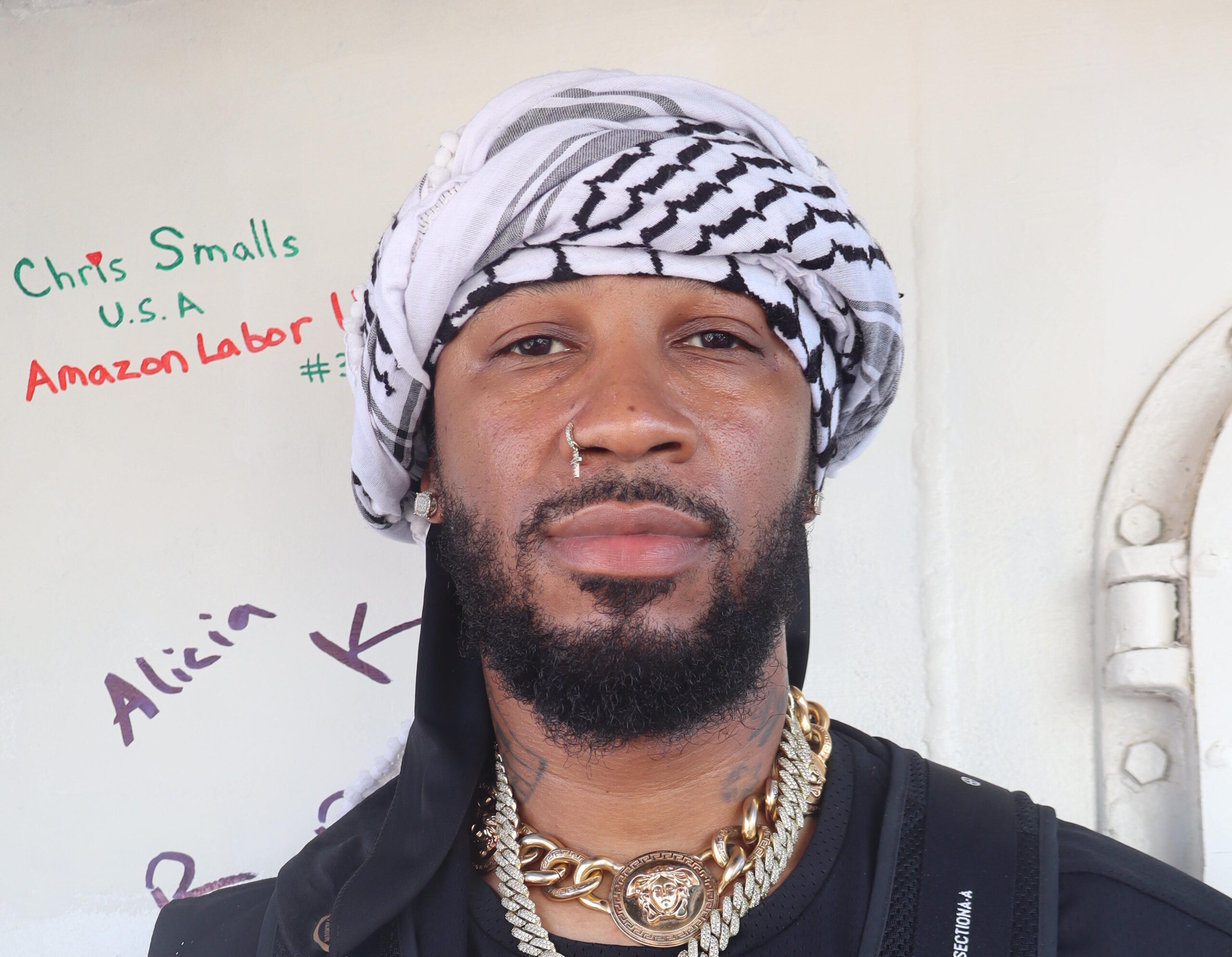
The following is a transcript of an interview conducted by Rashad Reza with labor organizer Chris Smalls on March 15. In this conversation, Smalls reflects on labor organizing, worker power, and the broader political conditions shaping struggle in the United States today.
We are publishing the interview in transcript form to make the full exchange available to our readers.
Rashad Reza: With me is Chris Smalls. Starting off, I wanted to ask about some stuff you had going on recently, I saw you were in Amsterdam with the PYM for the Hague Conference they were doing, how was that going?
Chris Smalls: Thank you for having me, appreciate the invitation to this webinar. Yeah, this past weekend in Amsterdam was a very powerful conference, it was called the People’s Conference – Friends of the Hague – meaning that we are 130 to 140 activists/delegates from around the world, different countries, that all came together this past weekend to discuss how we move forward in the Palestinian movement and the resistance movement on all different levels, from grassroots organizations all the way up to the United Nations repertoire, with Francesca Albinez being there, and other MP’s around the world, and other prominent figures, and we were just discussing how we can enforce and hold international courts of justice accountable, and also how can we amplify the case that they have against Israel, that they are committing war crimes, that they are committing genocide, and that these war criminals need to be locked up. We all know that what we witnessed for the last 2 and a half years are war crimes, and crimes against humanity, and these war criminals not only need to be brought to justice and held accountable, but they need to be arrested and they need to have arrest warrants out in every single country that they step foot in.
Rashad Reza: Yeah, definitely agree with that, and I’m glad you went to that and I know that, coming back from that, you’re about to go next week to Cuba, so one thing I wanted to ask you – one of my friends Kwudjwa had asked me a question for you – basically, we were just wondering about how workers here in the United States can better show solidarity with Cuba and orient better towards solidarity with some of the oppressed nations that we are going to be highlighting, especially Cuba?
Chris Smalls: Great question, great question. As workers, we got to understand what the Cuban people are going through, number one. This embargo, this inhumane embargo has been imposed for over 60+ years, 67 to be exact, and to understand that Cuba is one of the last socialist, communist, self-governed countries in the entire world, with one of the best healthcare systems, no homelessness, no mental health crisis there, no crime rate really – they have a 0.1% crime rate. Everyone takes care of one another is what I’m saying, and they have a really strong resilience, going back to Fidel Castro & Che Guevara days, fighting for their liberation, fighting for their sovereignty, is something that working class people around the world, all oppressed people, that’s something that we must always do when we’re facing the rise of fascism, as we see with this administration.
But this is not a Trump administration issue. This is a bipartisan issue, meaning that both parties – two-party system, the Democrats, Republicans – they both uphold the same type of blockade that we’re witnessing, and me as a worker here in the US – the solidarity that I’ve shown with Cuba; a few years ago, I had the opportunity to bring a labor delegation of Amazon workers from my union and we all went down to Cuba, we stayed for about 2 weeks, and not only did we learn the history, we got to see different communities outside of Havana. A lot of people just go down there to go to Havana, go to the tourist areas, but we didn’t do that, we did the complete opposite. We stayed in a rural area, we stayed in a place where things were limited. We had to take bucket showers, we lost weight because they didn’t have certain foods to eat. We were very disciplined in the program they put together for us.
At the end of the program, we were able to meet the president of the entire country, which was definitely a powerful moment for myself and for the entire union delegation that was there, and that’s the type of solidarity we need. We need to show our solidarity by just going down there. We also delivered humanitarian aid items. We delivered 60 pounds of medical supplies to the hospital. We delivered other things, we put money into the economy, and those are the type of things that we can do as Americans who have the freedoms and liberties to do that… but most importantly is to educate people. A lot of people regurgitate this false narrative that we all know is created by our oppressors to divide people, and a lot of people are not educated because they don’t understand, and we have to be the ones to educate them.
Rashad: I really like that answer, you brought up a lot of stuff I want to talk about here. Just as a preface, I had already talked about this with you earlier, but the college debate community… their resolution this year is about collective bargaining rights for workers in the United States, and there’s a lot of left-leaning debaters on this topic who are basically arguing that there is some negative elements of trying to pursue reform. One thing I wanted to ask you in relation to it being a bipartisan issue – one thing I’ve been thinking about is Zohran Mamdani walking back some of his previous anti-Zionist comments that I know you saw over the past couple days – one thing that Debaters have been wondering about this whole year was where we should spend our energy, especially for labor organizers, specifically for collective bargaining. As organizers, activists, and people putting our energy into trying to achieve liberation, should we be focused on trying to get rights for labourers into law, so that we can have rights for people to go on strike? Or, given what you said about fascism, bipartisanship, and perhaps some overall issues with trying to work with the government, should we not be focused on trying to codify rights for workers given that we have a government that doesn’t really respect workers’ rights, and just try to move forward and proceed anyways? What’s your take or spin on that?
Chris Small: This is a loaded question, but it’s definitely urgent to answer this one, because things is rough out here. I’ll just go by a little bit of what I experience with the National Labor Relations Board, and collective bargaining. Going back to the Biden administration… let’s start there. The Biden administration claimed to have been the most pro-union, pro-labor president in American history. That was their words, literally. The week he invited myself and the workers of Starbucks and 6 other unions to the white house… this was back in 2022. At the time, they had the Secretary of Labor, his name was Marty Walsh – very progressive guy, he’s from Boston, union guy – and it seemed promising, that they had Marty Walsh as the secretary of labor; they had Jennifer Abruzzo, one of the most progressive labor board attorneys in modern times, and there were some things that were moving on a federal level. There was a clause, or bylaws they passed, something that they called Cemex, for example what Amazon Teamsters are doing: they’re going to these buildings, they’re dropping off union cards, and they’re filing under this Cemex law where they’re basically trying to skip out the elections but say hey, we have a majority in the building […] and they are basically trying to bypass what we had to go through, which was elections. So that’s something that was really good for the Biden administration, but at the same time, we didn’t really enforce the National Labor Relation Board, because the board was already $20 million in debt, and it’s already understaffed.
So basically, for all you organizers who’s going through collective bargaining battles or disputes or even strikes, right now – you won’t get very far, because since the Biden administration, the board has been dismantled. And what I mean by that, we got to go back to the Biden administration – Marty Walsh stepped down, he just left the administration and literally took a job at the hockey league. I don’t know why he did that, but that was his personal choice. So, they basically had a temporary labor secretary of the entire government, her name was Julie Su. And I’m glad you brought up Zohran, ‘cause guess what? She now works for Zohran. I know a lot of people may not know this, and I’m connecting the dots here, because it’s important that you guys know who these people are. Julie Su was our Secretary of Labor for almost over a year and a half under the Biden Administration, and nobody really cared. Nobody even knew, she really didn’t do much.
And then, after the first 10 days of Trump in office, what did Trump do? He fired everybody. Every progressive from the board. He dismantled the board within the first 10 days of his presidency. You know why he did that? Because he understands that attacking labor, attacking our rights will obviously hinder us or dismay us from trying to organize. Even billionaires know or understand the power of organizing, to put that into perspective. Once again, we’re dealing with…. right now until this day, we’re dealing with a dismantled board. Right now the board is not even complete, so if you do file what they call an unfair labor practice, a ULP as you guys know – if you file one of those right now, chances are it’s going nowhere, because I can tell you from our own experience and over 175 ULP’s I filed against Amazon alone, that maybe a small percentage of those ever even made it to a board-level. Maybe two or three cases out of the last three years made it to a federal level. Everything else, they try to push back down on the states, and that makes it harder.
They play this game, corporations will play this game where they want to keep you in a legal battle, and keep you away… your focus off of organizing. But you got to do both at the same time. You got to fight the legal battle, but understand the legal battle is not going to get you the victory you want. To get you the victory you want, to answer your question, is just going to be straight up organizing. You have to continue to educate people, and you got to re-educate people, because the turnover rate at your employer or your workplace may be high, especially at Amazon, and the only way that you’re going to continue to win these small victories is by keeping people on the same page, and keeping people militant.
Rashad Reza: Okay, I really like that you brought up all the specific bureaucratic administrational hurdles, because a lot of the time we have – especially in Debate – we have liberal reformists who just kind of assume everything political just happens instantly, super efficiently, and I really appreciate you bringing that up because it kind of shows that a lot of the times, the government, especially in relation to the NLRB, isn’t moving as fast as we would like them to do for any revolutionary or liberatory ends.
Chris Smalls: Absolutely.
Rashad Reza: So, one thing I wanted to ask you was about secondary strikes, just striking for any action not immediately tied to better working conditions – I’m thinking about Minneapolis – I’m wondering, one thing that’s brought up a lot this year is people worried about going on secondary strikes because they’re not legally protected, and they might not always be supported by a union, depending on where they’re at. What would you say to people, or for organizers, trying to convince people to go onto strike, to make sure that we have lots of people willing to engage, even if there’s not legal protections behind everything?
Chris Smalls: Well, it’s really ironic, because mostly all strikes are illegal, even union strikes. People don’t know that. You know, corporations will come up with their own policy saying that going on strike is illegal, but if you win your strike, then that all goes out the window. A successful strike, you know… there’s no need to take you to court, because you guys won the battle. And that’s what we have to do. We have to break down these stigmas by saying that a successful strike is a victory. There’s no such thing as a loss. If you were able to strike and shut down the means of production and get what you want, get your contract, get your tentative agreement… if you were able to get those things, then you won the strike. Right? You know, of course, the employer, the corporation, the business… of course, they’re going to threaten you with trying to create that fear and doubt, saying that it’s illegal. The same thing with boycotts. They say employees are not able to boycott. That’s illegal. If they do boycott, the employer has the right to fire the employee right away, even if they’re union. So even with boycotts, unions can’t call a boycott. They can’t do it. Legally, they just can’t do it. So what they have to do is rely on the community, the outside organizations, grassroots organizations, to call – like you said, secondary strikes, secondary boycotts – so that it doesn’t fall directly on the employees at the place or on the union members. It falls on the outside. It’s a broader public opinion, and we’re protected by that public opinion, and that’s what we have to do. Well, actually, I want to say that’s what we have to do – that’s what unions have to do in this country. Unions – the reason, as you brought up Minneapolis – the reason why Minneapolis was so successful was because unions, for the first time in a very long time, understood that this was a working class issue. By them standing side by side with their community, it made the community stronger, and that’s what we need. We need more unions to not only not just fight about ICE, but also keep in mind that these same unions that stood side by side with these people in Minneapolis, are the same unions who were silent for Palestine.
Rashad Reza: Right.
Chris Smalls: They didn’t do anything, they didn’t say anything. So we have to understand that unions are not perfect. Unions absolutely are not outside the scope of being held accountable, and that’s what we have to call it out, is how do these unions say we’re going to stand up for ICE, but we’re not going to say anything about Palestine and not make that relation. And we have to call them out, and we also have to make sure that they uphold their pledge that they took. When they become union members or organizers, delegates, etc. When you become a union or trade unionist, you take an oath and your responsibility is to the working class. That’s the entire working class. So for them to not be vocal, as they were about Palestinians, is basically saying that everybody except Palestinians know we’re going to fight for them and that’s not right. That’s what we have to call out. And we got to make sure that they are, once again, investing into grassroots movements.
Rashad Reza: Yeah, so actually, I wanted to transition to the topic of imperialism next. That was a really good – I totally agree with you on unions not standing up for Palestine. And actually in the debate community, a lot of the critical leftists, just so you know, to piggyback off what you said earlier – they are very skeptical of unions in the United States because they think that unions have been unable to hold – and not every union, but lots of unions – have been unwilling to hold lines on things like imperialism, ICE, Palestine, Zionism, American nationalism, etc. One thing I wanted to ask you is, do you believe in successful labor politics that abandons the current structures of unions in the United States. Or do you believe that it’s about educating the unions first to sort of push them further and radicalize them? What’s your take on that?
Chris Smalls: Great question. Well, from my own personal experience and journey, which is very short lived, by the way – you know, I was fired from Amazon six years ago, as you know. I created – I founded the union in 2021, we were successful in 2022. So we’re talking about the last three, four years. My union is in Pampers, compared to most established unions. The most powerful ones in our country have been around for over 100 years, some of these unions. So in comparison, it’s really difficult for me to say what unions need to be doing, but from what I experienced and what I’ve learned from my own journey, is that there are unions around the world that are way more militant than what we have here, not even close. It’s night and day, actually.
And what I also learned is that our unions here are so tied to the two-party system, that they are allowing politics to lead their unions instead of the people. And we saw that right in front of our faces last year, when the presidency, when all of the unions in our country – all or most of the major unions, 60 unions under the AFL-CIO, whether they’re international or national unions – all supported Joe Biden and Kamala Harris for no reason. For no reason. And some unions took an even worse turn, and they supported the Republicans. They donated to Donald Trump, including the teamsters who we’re affiliated with. They gave Donald Trump $40,000 of union dues’ money. So, understanding that unions are selling us out by allowing politics, and politicians, particularly politicians – all these endorsements that they continuously give out for nothing in return. We can’t allow that. That’s number one. I do not agree with endorsing politicians. So it’s in my constitution in our union that we don’t endorse politicians. We don’t care how progressive you are. We don’t care if you have all the right talking points, if you show up to rallies. That’s not going to cut it for us. You got to show some tangible results before you can even talk about an endorsement to me, and that’s what we have to tell our unions.
We need to stop allowing politicians to use unions as props for talking points so that they can get elected, and then when they do get elected, we get nothing in return. And what I mean by nothing in return – our labor laws in our country hasn’t been touched since the 60s. Since 1960. We’re in the 21st Century. Joe Biden used a law to stop the striking workers for the railroad strikers from 1945. The 1945 act. So we’re in a completely different century and we’re still using this old-school, traditional-style, not-going-to-work, type of method against the working class. And, I’ll take it a step further, just saying that we need to push our unions to pull their money and endorsements out of politics until we’re able to actually get things in return, but we also need to educate them at the same time, and that means the things they need to do are simple, like for example, when the student encampments started off last year, that was a very good opportunity for unions to organize and stand side-by-side with students. That’s what happened in Italy just a few months ago when they were able to bring out 3 million people and go on a general strike in their entire country, because the unions stood side-by-side with the students. Every university was occupied. Every high school was occupied. Unfortunately, we do not have that in this country.
Rashad Reza: One follow-up to that, that Daniel Medina had asked – when it came to organizing anti-imperial protests for unions, what were some challenges you personally faced and how did you overcome the barriers?
Chris Smalls: Well number one, we were independent. We started off grassroots, from scratch, from nothing, from absolutely nothing. The day we beat Amazon, a $2.2 trillion company, my union had two dollars and fifty cents in our bank account… meaning that we didn’t beat Amazon because we were loaded in money and resources. We beat Amazon because we had people power. So, it’s just that simple. I was able to bring people together from all different backgrounds, all different creeds, all different ideologies, for one common cause. Jeff Bezos makes too much damn money. And that was the thing that brought people together, is that we have a billionaire flying to space, coming back down to Earth and thanking Amazon workers for paying for it. Meanwhile, Amazon workers are living in homeless shelters, they’re living in cars, they’re living on government food stamps, and also worse – they’re dying. We were dying. I lost so many coworkers just working at Amazon over the years. This was our opportunity to fight for our rights and protect ourselves, and we didn’t need the support of major unions, we did it ourselves. And we actually embarrassed the labor movement, because the labor movement has tried to organize Amazon for, I don’t know, ten to twenty years, just like they’ve done with Walmart. And the labor movement, and I mean some certain unions, have poured somewhere near $50 million into these campaigns and lost. 50 million dollars. And we did it with a GoFundMe. So we showed them that grassroots organizing is always direct action. Those types of things are always going to be the answer when it comes to our oppressors.
Rashad Reza: That makes a lot of sense, and I appreciate you saying that, because a lot of people think that you need a ton of money and backing for success, and really I think showing people that you just need the people, and you don’t need big money behind you, is one of the most important things to get away from a lot of this institutional attachment sentiment that a lot of unions operate on.
Rashad Reza: One criticism of unions I also wanted to ask you about, in a different vein, is just based on the historical legacies of racism within and around unions. I think that sometimes, some of these arguments get weaponized in certain ways, or ways that you probably don’t fully agree with – I was wondering, what would you say towards people that are skeptical of unions given their historical legacy of racism and also given that there’s been a lot of white unions that have historically excluded Black people and excluded working with Black-centered unions like the NNLC or the League of Revolutionary Black Workers in Detroit? What would you say coming from a more solidarity-based approach towards gaining that, or if not, how would you approach that?
Chris Smalls: I would say that people have every right to feel that way, because it’s true. There is a major, major, major issue when it comes to leadership and representation in the labor movement. I say major issue because I’ve been all over the country, I’ve been invited to several unions around the world – man, I lost count, 40 different countries around the world in the last three years – I probably been a keynote speaker or panelist or somebody to come talk to certain unions hundreds of times around this country, and when I walk in the room, I’m meeting majority – on an executive level – majority white men and white women. When it comes to certain unions, there is representation, but when it comes to an international level, it’s not there. It’s just not there. For the first time in 100 years, SCIU just voted in their first Black woman, and everyone was clapping right?
Rashad Reza: Wow.
Chris Smalls: Exactly, it’s like – yeah that’s great, that we finally, after a HUNDRED years, got the first Black woman of an international union in our country, and that just happened last year. That is not only telling of how disconnected we are, but how representation is not fully in the labor movement as well. I tried my best to make sure that under my presidency, when I was the president of my union for three years, I had majority women and majority women of color, something that is rare and that you would hardly see in any other executive room when it comes to union leadership. That is something that most unions don’t have, unfortunately, and we have to do, once again, the same thing – hold them accountable, and say that women of color, people of color, Black people, Brown people – we all deserve to sit in those executive seats as well. We’re not just due-paying members, we want to make sure that we have a voice as well, and we want to have representation.
Rashad Reza: So I wanted to ask a follow up about a lot of these internal hierarchies with the unions you were talking about. Do you think that… do you believe that some of these unions with very, I guess, rigid hierarchies with predominantly white men who are, for example – I’m thinking of when the UAW endorsed Biden, and we protested them here in Detroit and tried to talk to them, and it just seemed like there was nothing we could say to get across to them – do you think that they’re immovable on some of these things, or maybe it’s a more long term thing that we need to keep agitating on and pushing on to get them to change their minds.
Chris Smalls: I think you got to… I think you got to do both.
Rashad Reza: That makes sense.
Chris Smalls: I think you got to agitate as much as possible, and continue holding them accountable. But also – think of a way to transition, because, once again, Shawn Fain, the president of the UAW… he’s in a union in one of the most blackest cities in America. So when it comes to, once again, representation – and before Shawn Fain, there was a Black president. So we got to transition at times. And there’s nothing wrong with that, honestly. He can be a great leader. But once again, all unions are not perfect. So, if their union members – not speaking for them – but if they feel that he’s not representing them, then you have every right as dues-paying members to transition and push for that transition, especially drawing a red line. Like, if Palestine is something that is a red line for people, then absolutely agitate as much as possible. And if it’s representation, then absolutely, same thing, you have to do both. You have to educate and also agitate, the same thing.
Rashad Reza: I appreciate that. Speaking of Palestine, I wanted to talk about the Gaza Flotilla that we had talked about before, that happened last summer. I wanted to ask you, what was the response from labor movements and labor – you know, the union side of things – when you did that. Was it a lot of support there, or was it sort of mixed?
Chris Smalls: Absolutely not. No. There was no support. I didn’t expect the labor movement to support when I was released from prison. Being a labor leader in this country, it was very eye-opening to me to see that only a handful of unions even said anything about what happened. And once again, these are unions that, flew me all over the country, who invited me into their headquarters, who invited me to be keynote speakers, motivate their members, do all of the above – that said absolutely nothing when they all witnessed what happened, unless they were under a rock, which I highly doubt. So, it just tells you how disconnected it was, it’s just confirmation of how disconnected our labor movement is in our country.
I don’t want people to think that I’m… I don’t want to sugarcoat it. You know, right now, our labor movement in the US is failing us. It’s failing us tremendously… failing us so bad that union membership in our country is in the gutter. Union membership in the private sector is less than 6% and union membership in the public sector is less than 9%, and that number declines every single day, because the jobs that are being created are not unionized jobs, and we’re not even talking about the threat of artificial intelligence. So when I… once again, when I spoke up about Palestine, which is also a working class issue – do the unions have another opportunity to be on the right side of history themselves? Just think about it. The entire world, including a majority of America now – which that narrative changed over the years – supports the Palestinian Liberation. And, for unions to not take this as an opportunity for them to stand side-by-side with everybody and organize them into the movement – this tells you how disconnected they really are, and how they continue to allow, once again, as I mentioned before, to allow politics to lead how they organize. And because of that, just how the Democrats was disconnected last year, our unions are still disconnected.
Rashad Reza: Yeah. One thing I was wondering about in relation to that, and what you had said earlier was… you had said: “think of a way to transition”. And you had also talked about militancy. I think a lot of leftists on the debate topic, one of their conclusions is that there’s sort of a trade-off between trying to get the union to do stuff, and trying to put energy and time towards more militant efforts, you know – whether it be going on the Flotilla or just, Revolutionary Black Radical Tradition organizing in the US. So I was wondering how you balance your time between those two, just on what you want to put your time and energy into at the moment, if that makes sense.
Chris Smalls: Yeah, yeah, it makes sense. I mean, see the thing is with me and with my union in particular, is that we’re a little bit unique because even though we started off independent, I ended up – because we’re taking on Amazon, which is a trillion dollar company that’s held us up in federal court for years and years with their million dollar lawyers – their plan is to allow our union to starve out and go bankrupt by keeping us held up in court. So the affiliation with the Teamsters for us, helps us sustain ourselves financially, and with resources. The thing is, with a part of that agreement that I signed, we have full autonomy and full jurisdiction on Amazon, meaning that Teamsters, as big as powerful they are – they can’t tell my union, the ALU, the Amazon labor union, IBT – they can’t tell our union how to organize, or what to do, actually. They can only support, they can recommend things, but they can’t tell us how we should organize. And I think that’s the most important thing. I have the freedom to do radical things and put my life at risk getting on the Flotilla. Other people may not have that. They have a lot of restrictions in their unions, depending on your union’s contract, constitution, etc. I don’t know all of the rules and regulations or bylaws, but with our union in particular, we had that autonomy, and I think that’s very important to have the power to do what you want to do, when you want to do it, and how you want to do it.
Number two is we got to think outside the box, like I mentioned before. A lot of unions are still stuck in this old school, traditional-style organizing, where they think that they can do a couple of rallies, they can show with some leaflets, and they can just show up with some goodies, give out some hats, and they think people are just gonna flock to them, and it’s so boring. It’s terrible.
Rashad Reza: Agreed.
Chris Smalls: It’s terrible. We got to stop doing the same thing. We have to think outside the box. I would have never beat Amazon if I didn’t give out weed. And that’s just something… that’s one of many things. And I say the give out weed part, because it was a funny thing in our – if you watched our documentary, everybody always talks about that – that one moment where we had a setback. We had a setback because we had to refile and we only had a certain amount of time, and I couldn’t think of shit else to do. And I’m like, hmmm, what is something that I can do, that Amazon can’t do, and won’t ever do? Hmm… give out some free weed. And it worked. And it wasn’t to bribe people. It was to have a conversation. That was it. I only was giving it out so I can even have an opportunity to talk to people at a rapid pace, which it worked like a charm. When the rumor – because working at Amazon that has thousands, it’s like a rumor in there: “Oh, did you hear what the union is doing outside? Go see them after work.” And those types of outside-of-the-box, outside of traditional-style organizing methods… and I’m not saying you got to give out just weed, because we gave out books, we gave out food, we gave out literature, we gave out backpacks for kids during the school year. We gave out plenty of things, different things. We had Christmas parties, we had giveaways. We paid for people to Uber home if it was an emergency. We did so many little details that Amazon would never, ever do, right? Giving out weed was just the icing on the cake. But what I’m saying is just thinking outside of the traditional-style methods of organizing. Be creative as you want. What really got me in trouble with Amazon was actually TikTok videos.
Rashad Reza: Wow.
Chris Smalls: They sued me four times because they wanted me to stop making viral Tiktok videos on their property.
Rashad Reza: Ridiculous.
Chris Smalls: Exactly. So ridiculous that they had to spend money on it. And that’s something – these are the things that we have, the creativity that we have, the technology that we have, and the things that we can do nowadays to organize – it gives us the strength, and that’s the way we have to play chess with the employer or oppressor. Figure out a way to be two steps ahead of them all the time.
Rashad Reza: Yeah, I really like that, being creative, and that really does give me hope that there is a way forward without traditional, union politics for the labor movement. So, speaking about specific tactics – Ashlyn Davis, an organizer in Oklahoma, had asked: how effective or, what I think she said – should we as organizers start focusing more on rolling strikes over expanding BDS lists?
Chris Smalls: Well, here’s the thing. So, I love the strikes, and I love calling for strikes, but as I mentioned, we’re in a country where we have so low of union density that calling the strike really wouldn’t get too far if folks are not on the same accord. And I think the first thing we need to do is escape the two-party system, which… this is wishful thinking. But this is something that is an aspiration of mine, is getting unions to stop endorsing the two-party system. And I think that’s where we start, right? We tell unions, we get them to stop endorsing these politicians, until they give us something in return, right? That’s number one. Then we hold unions accountable for not fighting or standing side-by-side with grassroots movements. Because I know you guys know plenty of organizations that do great work, that do good radical things, or do good things in the community, that unions don’t even care to listen to, or have a conversation with, right? Because they’re not union members, or they’re not delegates, or they don’t have voting power, and we have to get unions to stop that as well. We have to get unions to meet with these community leaders and activists and organizers and grassroots efforts, because that is real people power. Unions don’t have all the answers. They absolutely don’t. They may have resources, but they don’t have the answers, and by them not even willing to host a conversation with people in the community, from the community, they’re not doing themselves a service. And also, that ties hand-in-hand of not organizing people into unions. If they’re not going to meet people where they at, then how the hell do they expect people to just show up one day and say, “You know what? I want to be a member!”. It doesn’t work that way. I can tell you – once again, going back to how we did it at Amazon – it worked because I set up an encampment for over 300+ days outside of the same building that fired me in 2020. For over 300+ days, I was outside talking to people every single day – rain, shine, night or day, hot or cold. And that consistency, longevity, having not one conversation, but several conversations… that is what got us over to our victory. And our unions, unfortunately nowadays, like to take shortcuts. They like to, as I said, dress it up: call these strikes; post up on Instagram; make a pretty flyer; say they’ll give out some free hats and goodies or pizza; and that’s not going to cut it anymore. We have to really build power by meeting people where they at, and also figuring out who they are on a personal level. I tell my organizers this all the time. If you want to organize people, you got to get to know them on a personal level. You can’t just go over there because you’re radicalized, expecting them to be like that. You have to understand who they are as a person. Where do they… where is their family from? Where do their kids go to school? What are the activities they like to do in their free time? Where do they play at? Where do they… what parks do they visit? These types of questions will help you, or guide you, to the type of questions you can ask them to get them into the movement. But you don’t want to start off with: “hey, we need to shut this shit down right now!”, because that’s never going to work. That always – usually, nine times out of ten – is going to end up in a disconnect. And you don’t want that.
Rashad Reza: Yeah, someone had asked on a follow-up about – I think you had mentioned something about getting support from larger unions – she asked, “I know they were still autonomous, but does that mean there was a price to pay for getting the support?” Yeah, I guess…
Chris Smalls: Absolutely, yeah, I get the question. No, it was no price. We – first of all, we don’t have a contract with Amazon, so we don’t – none of my members pay any dues. We don’t have any money, so we don’t have dues-paying members, and we definitely damn sure didn’t have any money to give them. So there was no price. Once again, this agreement – who I carefully went over with my entire executive board and my legal counsel – this agreement favored us heavily because we actually got money out of the Teamsters, believe it or not. They are the ones that are – well, not paying for everything, of course, not all of our expenses; we have our own donations and crowdfunding, but what we are now able to offer is $1,000 a week for people to go on strike. So if my building wanted to call a strike and go on strike, we are now able to offer them $1,000 every week that they strike, and that money comes from the International Teamsters, who have $350 million worth of strike money. So you know, actually, we got the better end of the deal.
Rashad Reza: Yeah, no that’s great. Two more questions I had, and then we can wrap up. First from my friend Kwudjwa again. They were wondering about the co-option of anti-globalist and pro-Palestine rhetoric from some of the Right. They were asking, basically, given that some – I don’t know if you’ve seen Nick Fuentes, or some of these right-wing people who now support Palestine, weirdly in their own way, but not really that much in a liberatory way – basically just asking, do you think that there’s any way to agitate these contradictions, or what’s your stance on that? Because I know you are very pro-Palestine and by any means necessary. So what, I guess, is your stance on some of the co-option of that by weirdly conservative right-wing forces?
Chris Smalls: yeah, yeah. I’ve seen it a lot. You know, it’s ironic because, yeah, you’re seeing Nick, you’re seeing Candace Owens, you’re seeing the Tucker Carlsons of the world…
Rashad Reza: Yeah, Kwudjwa brought up those.
Chris Smalls: You’ve seen a lot of these folks that are obviously conservatives starting to have a different opinion and some of it… it actually sounds really promising, the things they say about Palestine. They’ve done some homework, they’ve done their research. But, it’s this saying that we say in the movement, is that: we’re not going to liberate Palestine. Palestine is going to liberate us. So that is exactly what we’re witnessing right now, is that people are being liberated by Palestine. And, do we call these people our allies? Absolutely not. Are they allies to us? No, absolutely not. But if Palestine is going to bring us a little bit closer, that’s fine with me. That doesn’t mean that we don’t… that we can’t debate with them, or we can’t hold them accountable, or question their opinions, or even if you want to invite them to have this conversation, I encourage that too. Because we on the left, we can talk to each other, and everybody wants to be heard on the left. That’s one thing about the left in the US. Everybody got something to say.
Rashad Reza: Right.
Chris Smalls: Everybody. Everybody wants to be heard, everybody… and that’s fine, because we don’t get heard by the Right side? And that’s our biggest problem. Because we don’t get heard on that side, we got to scream at each other. Sometimes that can be good or bad. We all know. It’s always something in the movement. But when it came to what I saw, even once again, going back to how we organized in Amazon – Staten Island is the only red borough out of the five in New York City. A lot of people don’t know that. It’s literally called Trump Island, aka Trump Island. There’s Trump flags everywhere. There’s 8,300 people that go to my one building. So, obviously, a large population of them are not even on the left. So I couldn’t go over there talking ‘whatever whatever’… I had to make sure that I kept the focus, and that our organizers kept a focus on: who? The billionaire. Because it doesn’t matter what your political ideology is. Once again, the one common thing that brought us together was Jeff Bezos made way too much damn money, and we want our fair share. So this is the same thing we’re seeing now. We’re seeing people that we haven’t heard talk about Palestine start to talk about Palestine, and some of them are even taking it a step further, like Tucker Carlson. I think he went over there and got detained and everything. So yeah, let him go through his own liberation in his own way. But that doesn’t mean that he’s an ally. It just means… it just means that there’s one common cause that we agree on, and that’s it. You know, we can agree on this one common cause, that the people of Palestine need to be free. And I’m fine with that. But will I… will I organize with them? Will I bring them into my close circle? Absolutely not. I would know exactly who they are. I will keep them in that space. But I will have the conversation – if there was to have – with them, because I do agree that we should talk to different spaces. You know, actually, I went on Tucker Carlson’s show. I’ve been on his show in the past, when he was on Fox News.
Rashad Reza: Wow, I didn’t know that.
Chris Smalls: Yeah, you can go look that up. A lot of people on the left was giving me shit for it. They’re like, “why did you go on Tucker Carlson?” And I said, “are you stupid? He has the number one show in America, with 8 million people watching every single night at eight o’clock?” Most of these people that watch it, whether they’re left, right, or in between – a lot of them are working class people that work… some of them work at Amazon. So that’s why I went on the show. I don’t give a fuck who I’m talking to. It’s about getting the message out. And that’s what we have to do. We have to, sometimes, have uncomfortable conversations with uncomfortable people. But we’re supposed to make people uncomfortable. That’s what a protest is… is to make people uncomfortable. And I would end off with this as well, when it comes to this question, is this goes back into unions thinking outside of the box. The reason why we’re not organizing folks into the movement is because they’re not willing to go to different spaces, and we have to stop that.
Rashad Reza: Yeah, yeah, that makes a lot of sense. Yeah, let’s see… the last thing I was going to ask is, when it comes to what unions should push for… what would you say for people that work jobs that aren’t unionized right now? Or, in debate, we talk a lot about the informal economy or the gig economy. I remember being a DoorDash driver, and I didn’t even know how to go about trying to get unions involved. So, what would you say for people that work in the informal sector, so to speak? Since you have a lot of experience making a union where people never even thought you could have a union before, what would you say for labor politics for people in sectors that don’t have official unions or don’t have labor rights… what would you say to them for organizing towards liberation or labor-based ends?
Chris Smalls: Yeah, I mean, it’s the same. I would tell them they can organize regardless. Everybody has rights. A lot of people don’t know their rights. Unfortunately, when it comes to gig workers and independent contractors, there’s two battles you’re taking on at the same time. You’re taking on the battle of your employment status, right? Being called the independent contractor, whether you’re delivering or whether you’re working at Amazon… even the Amazon drivers, they’re not Amazon workers. Those are third-party. A lot of people don’t know that, that these people that are delivering your packages are not actual Amazon workers. They work for the dispatcher who is a third-party, and they still have to wear the Amazon vest and drive the Amazon trucks. But they’re the same. They’re just like gig workers, just like DoorDashers or Uber drivers. They do not work directly for the company. They are independent contractors, and because of that employment status, they’re not able to organize. But that’s just not true, because we’re doing it, and you can still organize the same way. You may not have the same protections, but if you can, once again, bring together enough people, you have some power. Just imagine if you as a DoorDash or Uber driver – if you got together with a hundred different independent contractors, drivers, or whatever – if you got together with them in your own little city center, community space, or just your hometown, whatever it may be, in your own community. If you garnish that much power, where, if y’all all decided we’re not going to – this has been happening in Tennessee, by the way, there’s a there’s a campaign right now with taxi drivers versus the Uber drivers down there, where they started their own independent Union… it may not be a formal union, but they are calling themselves Taxi Drivers United, and they are basically banding together, saying that – if we all sit out, or we all turn off our app at the same time… that’s a form of resistance, and that puts a really big dent in the company’s revenue, because that one area won’t get any service for people, and it’ll backfire, because now customers are going to do the dirty work for you guys. They’re going to reach out and say, “Hey, what’s going on? It’s taking me 30 minutes to get a ride,”…. “Hey, what’s going on? It’s taking me whatever to get my food”… that will hurt the company’s PR, which we all know that THAT’S what companies care about more than anything. For example, when you look at an Amazon commercial, everybody’s always happy and smiling. That’s their logo, right? The smile. They want to put on this perception that everything’s good, that everything’s fine. Working for them is great. You see all these commercials they do with people being delivered packages, and they’re friends with the driver… but that’s not the reality of the situation. A lot of people don’t see that stuff, [or] what goes on behind closed doors. So it’s up to us to not only educate our loved ones in our own community, but also understand that no matter where you work, no matter what company, what sector – that you absolutely have the right to organize, and the right to organize doesn’t matter if you’re an independent contractor or not. You have the right to get together with your colleagues, your co-workers, and try to form something collectively and negotiate a contract that you see fit with the employer.
Rashad Reza: Yeah, that makes a lot of sense to me. Yeah, that’s all the questions I had. You gave really comprehensive answers on all of the main things I was going to ask about: imperialism, reformism, anti-Blackness, labor tactics… and honestly, that was all the questions people have submitted. So, yeah, I’m okay with wrapping it up, if you are. I appreciate you coming through. Stay safe in Cuba and again, really appreciate you coming through, man. People in the debate community are definitely going to use a lot of what your thoughts are on unions, since a lot of the information you gave I think is definitely going to rupture how a lot of people think about things, because [the] stuff you said is a lot of stuff that I haven’t even heard this entire year that any tournament, and even with labor organizers in Detroit as well. So again, we appreciate your insight. Yup, everybody in the chat is saying that this is incredible. So yeah, again, thank you so much, man.
Chris Smalls: Absolutely no doubt. I appreciate you guys, and yeah and you guys stay safe as well. Solidarity. Take care.


Leave a Reply